Wellington:
(04) 801 6228
Lower Hutt:
(04) 570 0520
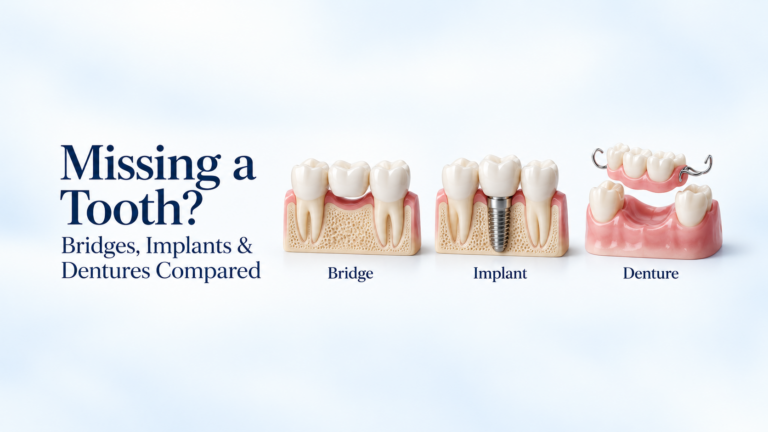
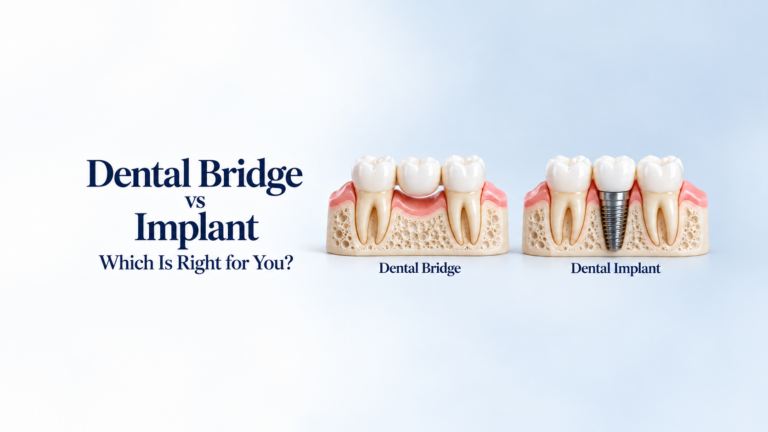
A dental bridge fills a gap by fixing a false tooth to the teeth on either side. An implant replaces the root itself with a small titanium post in your jaw, then adds a crown on top. A bridge is usually faster and costs less up front. An implant leaves your neighbouring teeth alone and tends to last longer.
Neither one is the "right" answer for everyone. Which suits you depends on the health of the teeth next to the gap, the bone underneath it, your timeframe and your budget. Here's how we lay out the tooth bridge vs implant choice for patients at our Wellington and Lower Hutt clinics, so you can weigh it up for yourself.
A bridge is a false tooth (called a pontic) held in place by the teeth around the gap. It's fixed in, so you don't take it out at night. There are three main types:
A traditional bridge usually takes two appointments a couple of weeks apart: one to prepare the teeth and take a scan, and one to fit the finished bridge. You wear a temporary bridge in between. Our dental bridges page goes through each type in more detail.
A dental implant is a small titanium post placed in your jawbone where the tooth root used to be. Over three to six months, the bone grows around the post and holds it firm. A connector (the abutment) and a crown then go on top, and the gap is gone.
Because it's anchored in bone, an implant stands on its own. It doesn't need anything from the teeth next to it. If you'd like the step-by-step, our post on what to expect during a tooth implant walks through each appointment.
| Bridge | Implant | |
|---|---|---|
| How it's held in | Supported by the teeth either side of the gap | Anchored in your jawbone by a titanium post |
| Effect on neighbouring teeth | Traditional bridges need them reshaped for crowns | Neighbouring teeth aren't touched |
| Surgery | None | Minor surgery under local anaesthetic |
| Time from start to finish | Usually 2 to 3 weeks | Usually 3 to 6 months, longer with a bone graft |
| How long it lasts | Often 10 to 15 years with good care | The post can last decades; the crown may need replacing at some point |
| Cleaning | Brush, plus clean under the false tooth with floss threaders or interdental brushes | Brush and floss much like a natural tooth |
| Effect on the jawbone | Bone under the gap can slowly shrink over time | The post helps keep the bone in place |
| Typical cost (NZ) | About $3,500 to $6,000 for a three-unit bridge | About $5,200 to $6,500 for a single implant and crown |
On lifespan, the research backs up what we see in the chair. A large review of tooth-supported bridges found about 89% were still in place after 10 years (Tan et al., 2004). For implants, a systematic review put 10-year survival at about 96% (Howe et al., 2019). Both are good numbers. The difference is real, but it's not the only thing that matters.
A bridge is often a good choice when:
An implant often makes more sense when:
Bridges and implants aren't the only missing tooth options. If you've got more than one tooth missing in a row, there's a middle ground: an implant-supported bridge, where two implants hold a bridge between them. And for some people, a partial denture is the simplest and most affordable way to fill a gap.
We'd rather you see real numbers than "contact us for a quote".
A bridge costs less on the day, but it's worth thinking about the next 15 or 20 years too. A bridge may need replacing once in that time, and an implant often won't. On the other hand, if the neighbouring teeth needed crowns anyway, a bridge can be the better value.
Your own figure depends on your mouth, the materials and how many teeth are involved. After your consult you'll get a clear, itemised cost, the same fair price we'd give anyone. We've got payment options if you'd like to spread it out, and we can help with insurance claims.
Sometimes nothing much, at least for a while. A gap right at the back that doesn't affect your bite or your smile can be fine to leave. Over time, though, the teeth beside it can tip into the space and the tooth above or below can drift down. That can change your bite and make those teeth harder to clean. The bone where the tooth was also tends to shrink, which can make an implant harder to place later.
None of that happens overnight, and there's no rush to decide today. It's just worth knowing, so that if you wait, you're choosing to.
At your consult, we'll take a scan and X-rays so you can see the gap, the teeth around it and the bone underneath on the screen with us. We'll show you what we can see: whether the neighbouring teeth would benefit from crowns anyway, how much bone there is, and what each option would involve for you. Then we'll give you the costs for each and leave the decision with you. We offer both bridges and implants, so we've no reason to steer you one way.
If you'd like to see your own options, you can book online in Wellington or in Lower Hutt.
Not always. An implant usually lasts longer and doesn't affect the teeth next to it, but a bridge is quicker, needs no surgery and costs less up front. If the neighbouring teeth already need crowns, a bridge can be the better choice.
With good care, a bridge often lasts 10 to 15 years, and sometimes longer. Brushing twice a day, cleaning under the false tooth every day and coming in for regular teeth cleans all help it last.
Yes. If you're missing two or more teeth in a row, two implants can support a bridge that fills the whole space. It doesn't rely on your natural teeth, and it needs fewer implants than replacing every tooth one by one.
The teeth are numbed with local anaesthetic, so you shouldn't feel pain while they're prepared. They can feel a little sensitive for a few days afterwards, which usually settles on its own.
Usually, yes, on the day. A three-unit bridge is often about $3,500 to $6,000, compared with about $5,200 to $6,500 for a single implant. Over 15 to 20 years the gap can narrow, because a bridge is more likely to need replacing.
If you're weighing up a bridge or an implant, the first step is the same for both: we take a look, show you what we can see and talk you through the options and the costs. No judgement if the gap's been there a while.
You can see us at either clinic:
No rush. Let us know if you've got questions about your options.
At Supreme Dental Concepts, we provide a comprehensive selection of cosmetic dentistry services designed to give you the confident smile you desire.
Our commitment extends to ensuring you look your absolute best.
As dentists, our training in injection techniques and facial anatomy during dental school equips us to preserve your youthful appearance, complementing your beautiful teeth.