Wellington:
(04) 801 6228
Lower Hutt:
(04) 570 0520
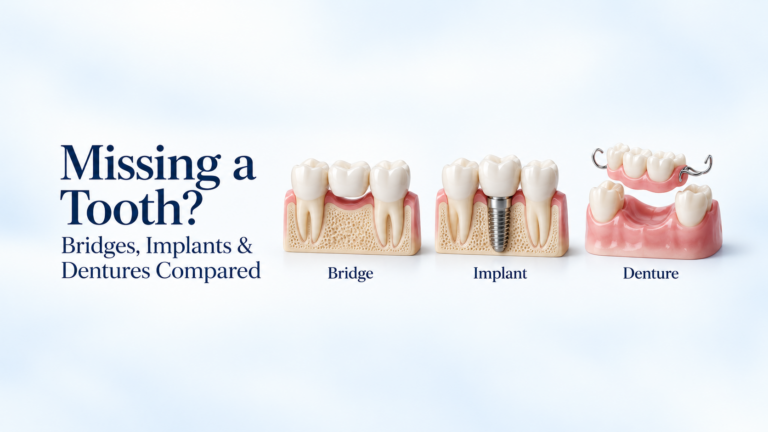
There are three main ways to replace a missing tooth:
There's also a fourth choice, which is to leave the gap for now. That can be fine in some spots.
None of these is right for everyone. It comes down to how many teeth are missing and where, the health of the teeth around the gap, the bone underneath, and what you'd like to spend. Here's how we talk through the missing tooth options with patients at our Wellington and Lower Hutt clinics.
| Partial denture | Bridge | Implant | |
|---|---|---|---|
| How it's held in | Clips onto your natural teeth | Fixed to the teeth either side of the gap | Anchored in your jawbone by a titanium post |
| Removable? | Yes, you take it out to clean and at night | No | No |
| Surgery | None | None | Minor surgery under local anaesthetic |
| Effect on other teeth | Minimal; clips rest on neighbouring teeth | Traditional bridges need the neighbouring teeth reshaped for crowns | Neighbouring teeth aren't touched |
| Time from start to finish | Usually 2 to 4 weeks | Usually 2 to 3 weeks | Usually 3 to 6 months |
| How long it lasts | Often 5 to 10 years, with adjustments along the way | Often 10 to 15 years | The post can last decades; the crown may need replacing at some point |
| Typical cost (NZ) | About $1,000 to $2,800, depending on the type | About $3,500 to $6,000 for a three-unit bridge | About $5,200 to $6,500 for a single implant and crown |
A lot of people picture dentures as a full set in a glass by the bed. For one or two missing teeth, though, a partial denture is a small plate that fills only the gaps. It's the simplest way to replace a missing tooth, it costs the least, and it needs no surgery and little or no reshaping of your own teeth.
If most or all of the teeth in one jaw are missing, a full denture replaces the whole arch. An upper denture stays in place by suction against the roof of your mouth. A lower one has less to hold on to, so it can take longer to get used to. That's where implants can help (more on that below). Our dentures page covers full and partial dentures in more detail.
Most people need a couple of weeks to settle in. Your mouth might feel full at first, and "s" and "th" sounds can take a little practice. Eating is easier if you start with softer food and cut things into smaller pieces. You take a denture out to clean it and overnight, which gives your gums a rest.
A denture won't feel quite like your own teeth. It's a good, practical way to fill a gap, and for many people that's what they're after.
A bridge is fixed in, so there's nothing to take out. It's usually finished in two appointments a few weeks apart. The trade-off is that a traditional bridge needs the teeth either side of the gap reshaped for crowns. That makes the most sense when those teeth already need crowns anyway.
An implant stands on its own in the jawbone, so it leaves the neighbouring teeth alone and feels most like a natural tooth. It takes longer (three to six months, while the bone grows around the post) and costs more up front, but it tends to last the longest. A systematic review found about 96% of implants were still in place after 10 years (Howe et al., 2019). Our single tooth implant page explains what's involved.
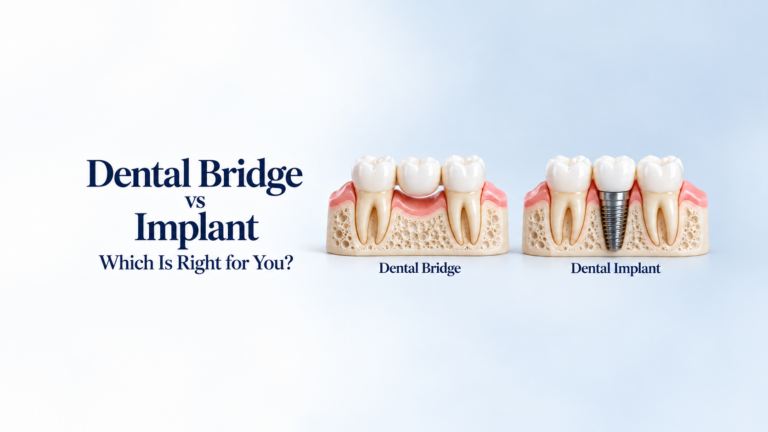
We've compared these two side by side in dental bridge vs implant: which is right for you?, including lifespan research and when each one fits best. For the implant steps, see what to expect during a tooth implant.
Yes. If you're missing several teeth, a few implants can do the work of many:
These six questions usually narrow it down quickly:
You don't need to have the answers before you come in. That's what the consult is for. If you'd like to talk it through, you can book in Wellington or in Lower Hutt.
We'd rather you see real numbers than "contact us for a quote". These are typical ranges for one missing tooth:
Implant-retained dentures and implant-supported bridges depend on how many implants are needed, so we'll give you an itemised figure once we've seen what's involved.
It's worth looking past the price on the day, too. A partial denture may need relining or replacing every 5 to 10 years, and a bridge every 10 to 15. An implant often won't need replacing at all. After your consult you'll get a clear, itemised cost, the same fair price we'd give anyone. We've got payment options if you'd like to spread it out, and we can help with insurance claims.
Sometimes, yes. A gap right at the back that doesn't affect your bite or your smile can be fine to leave for a while. Over time, though, the teeth beside it can tip into the space and the bone underneath tends to shrink. We cover this in more detail in our bridge vs implant guide.
There's no rush to decide. It's worth knowing, so that if you wait, you're choosing to.
At your consult we take a scan and X-rays, so you can see the gap, the teeth around it and the bone underneath on the screen with us. We'll show you what we can see and what each option would involve for you, with the cost of each. We do dentures, bridges and implants, so we've no reason to steer you one way. The decision stays with you.
An acrylic partial denture is usually the most affordable, at about $1,000 to $1,500. It's removable, needs no surgery and can be added to later if you lose another tooth.
Yes. A partial denture can hold a single false tooth. It clips onto the teeth either side and comes out for cleaning. Some people use one long term, and some use it while they decide on a bridge or an implant.
It depends on what matters most to you. An implant is fixed, feels most like a natural tooth and tends to last longest. A denture costs much less, needs no surgery and is quicker to make. Many people start with a denture and move to implants later.
With good care, a partial denture often lasts 5 to 10 years. Your gums and bone change shape over time, so it may need relining or adjusting along the way to keep it fitting well.
Usually, yes. If there's enough bone, implants can be placed later on. Sometimes your existing denture can even be adapted to clip onto mini implants.
If you're missing a tooth, the first step is the same whichever way you go: we take a look, show you what we can see and talk you through the options and the costs. No judgement if the gap's been there a while.
You can see us at either clinic:
No rush. Let us know if you've got questions about your options.
At Supreme Dental Concepts, we provide a comprehensive selection of cosmetic dentistry services designed to give you the confident smile you desire.
Our commitment extends to ensuring you look your absolute best.
As dentists, our training in injection techniques and facial anatomy during dental school equips us to preserve your youthful appearance, complementing your beautiful teeth.