Wellington:
(04) 801 6228
Lower Hutt:
(04) 570 0520
A regular clean is the least dramatic thing that happens at a dental clinic, and quietly the most useful. It's the appointment that catches the small stuff while it's still small, before a rough spot becomes a filling and a filling becomes something bigger.
If you've been putting it off, you're in good company. A lot of our patients hadn't seen anyone in years before they came in. This guide walks through what a dental hygienist in Wellington actually does, what happens during a professional clean, and why the six-monthly visit is worth keeping. No lecture. Just the honest reasons, so you can decide for yourself.
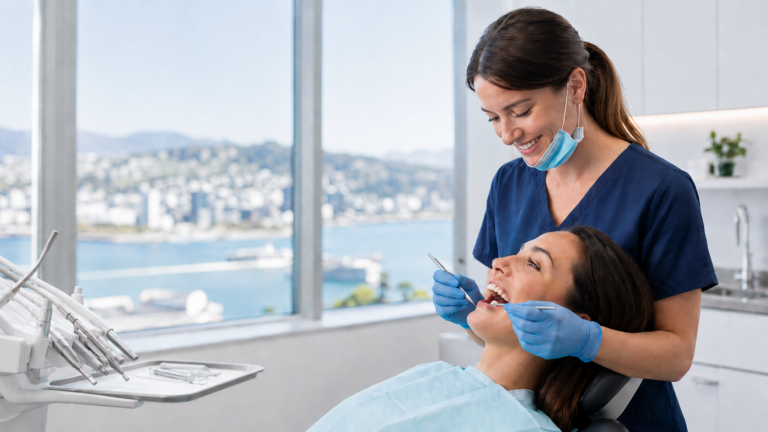
A dental hygienist is a trained oral health professional who focuses on preventing gum disease and tooth decay. They remove the hardened plaque (tartar) that a toothbrush can't shift, clean below the gumline, and show you how to look after your teeth between visits. Where a dentist diagnoses and treats problems like cavities and cracks, a hygienist keeps your mouth in a condition that stops those problems from starting.
In many Wellington clinics, the hygienist and dentist work as a team. You might see the hygienist for your cleaning and the dentist for your regular check-up in the same visit, so nothing gets missed and you're not making two trips.
A clean is usually calm and quick, and there's nothing in it to dread. Here's the shape of a typical appointment:
If it's been a long time and there's more buildup than usual, the clean might take a little longer or be split across two visits. We'll tell you what we can see and let you decide how to space it.
The short version: prevention is almost always cheaper, gentler, and less stressful than repair. Here's what a regular cleaning is quietly doing for you.
It stops gum disease before it takes hold. Plaque that sits along the gumline hardens into tartar, which irritates the gums. Left alone, it can progress from reversible gum inflammation (gingivitis) to periodontitis, which damages the bone holding your teeth in place. Gum disease is a leading cause of tooth loss in adults, and the early stages often have no pain to warn you. A hygienist catches it while it's still easy to turn around.
It catches decay while it's small. A worn spot or an early cavity is a quick, low-cost fix. The same tooth left for a couple of years can turn into a root canal or an extraction. Regular visits mean problems get found at the cheap, easy end.
It saves you money over time. Two cleanings a year cost far less than the treatment that avoidance leads to. Spacing out prevention is one of the simplest ways to keep dental costs down and predictable.
It keeps your breath fresh and your smile brighter. Removing tartar and surface stains does more for everyday confidence than most people expect, without any cosmetic work at all.
It's connected to the rest of your health. Research has linked gum health to broader health, including heart health and the management of diabetes. The science is still developing, and we won't overstate it, but looking after your gums is a sensible part of looking after yourself.
For most people, every six months. That rhythm suits the majority of healthy adults and keeps the buildup from getting ahead of you.
Some people need to come more often, around every three to four months, including those with gum disease, diabetes, or a tendency to build tartar quickly. Others with very stable gums might stretch to once a year. The honest answer is that it depends on your mouth, and a hygienist will suggest a schedule that fits you rather than a one-size-fits-all rule. (For more on timing, see our guide to how often to visit the dentist.)
They work closely together, but their roles are different. This table lays it out:
| Dental hygienist | Dentist | |
|---|---|---|
| Main focus | Preventing gum disease and decay | Diagnosing and treating dental problems |
| Typical work | Cleaning, scaling, polishing, gum checks, home-care advice | Fillings, crowns, root canals, extractions, cosmetic, and other treatments |
| When you see them | Regular cleans, usually six-monthly | Check-ups and when something needs fixing |
| Goal | Keep your mouth healthy so problems don't start | Restore and repair when problems appear |
In a clinic that keeps both in-house, you get the best of both in one place: the hygienist keeps things healthy, and the dentist is right there if anything needs a closer look. Not sure whether you need a hygienist at all? We answer that in “Do I need a hygienist?”.
Book a hygiene visit if you notice any of these:
None of these mean you're in trouble. They just mean it's time. It's also worth knowing what your gums are trying to tell you. And if it has been years rather than months, that's fine. We won't make you feel bad about it.
If the thought of the dentist makes you tense, a cleaning is one of the gentlest ways back in. It's non-invasive, there's no drilling, and it's often the appointment that reminds anxious patients that this doesn't have to be a bad experience. If nerves have kept you away, our guide to overcoming the fear of the dentist might help, too.
We work the way we do because so many of our patients arrived nervous. We listen first. We explain what we can see, in plain words, without the technical language that turns into fear in an anxious head. We show you your own mouth on the screen with an iTero scanner so nothing's hidden, and we go at your pace. You keep the decision the whole way through. There's no judgment about how long it's been, and no pressure to do everything at once.
The good news, if you're reading this, is that you're already thinking about it. That's the hardest step done.
We run two clinics across the region, so you can go wherever's easiest.
Our Wellington clinic is in Te Aro, on Tennyson Street, close to the central city, with extended hours including Saturdays. If you're searching for a dental hygienist in Wellington city, this is the one closest in.
Our Lower Hutt clinic is in Hutt Central, handy for the wider Hutt Valley. Both clinics offer the same gentle approach and most of the same services, and both book online through DentalHub. We also have Mandarin and Cantonese-speaking dentists on the team, so language is one less barrier if English isn't your first language.
On cost, our rule is simple: we give you a real price range up front, and it's the same fair price for everyone. No discounts, no limited-time offers. If you want a figure for your situation, give us a call and we'll talk it through honestly.
Most healthy adults do well with a clean every six months. If you have gum disease, diabetes, or build up tartar quickly, every three to four months may suit you better. People with very stable gums can sometimes stretch to once a year. A hygienist will suggest a schedule based on your mouth rather than a fixed rule.
A hygienist focuses on prevention: cleaning, scaling, polishing, checking your gums, and showing you how to care for your teeth at home. A dentist diagnoses and treats problems like cavities, cracks and gum disease, doing fillings, crowns, root canals and other work. They work as a team, and in many clinics you'll see both around the same visit.
For most people, it's painless and quite relaxing. If your gums are inflamed or it's been a long time, some areas can feel tender, and the hygienist can adjust and go gently. Tell them if anything's uncomfortable. A clean is one of the least invasive appointments in dentistry, with no drilling involved.
It varies depending on how much cleaning is needed, so the most useful thing a clinic can do is give you a real cost range up front rather than a vague “it depends.” We give you the range for your situation before you decide anything, support insurance claims, and keep pricing the same for everyone, with no discounting.
Nothing to be embarrassed about, and it's very common. There may be more tartar to remove, so the first clean might take a little longer or be split across two visits. We'll show you what we can see, explain the options in plain terms, and let you decide how to space things out. There's usually no rush.
A regular clean is the easiest habit to keep and the one that saves you the most grief later. If you're due, or well overdue, the simplest next step is to book a teeth clean.
You can book online through DentalHub at either the Wellington (Te Aro) or Lower Hutt clinic, ask about a virtual consultation if you'd rather start from home, or call us directly, Wellington on 04 801 6228 or Lower Hutt on 04 570 0520. Have a look at your options and decide in your own time. No rush.
At Supreme Dental Concepts, we provide a comprehensive selection of cosmetic dentistry services designed to give you the confident smile you desire.
Our commitment extends to ensuring you look your absolute best.
As dentists, our training in injection techniques and facial anatomy during dental school equips us to preserve your youthful appearance, complementing your beautiful teeth.